
NILOA Transparency Framework

Mitchell Community College is committed to maintaining the quality and viability of all programs and services in adherence to the North Carolina Community College’s State Board Code 1B SBCCC 400.3. To ensure continuous improvement, the College conducts a comprehensive review of each curriculum program, continuing education program area, and Career and College Readiness program at least every five years, consistent with regional accreditation standards. Additionally, the College assesses program-specific student learning outcomes annually and implements actions to enhance student learning outcomes.

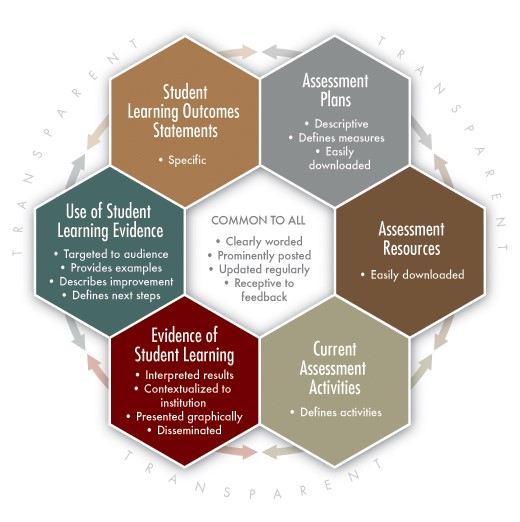
Credit: National Institute for Learning Outcomes Assessment
Student Learning Outcome Statements

Mitchell Community College designs program and course outcomes that are clear, precise, and easy to understand so students know exactly what they’re expected to learn.

Assessment Plans

The assessment plans for program learning outcomes are well-defined, providing specific, measurable objectives to support a comprehensive evaluation of student learning and program effectiveness.

Assessment Resources

Professional Development Resources for Student Learning Outcomes and Assessment

Current Assessment Activities

Examples of Assessment of Student Learning Outcomes

Evidence of Student Learning

Student data collection is thorough, with interpreted results that are contextualized, visually presented, and strategically shared to convey a straightforward, impactful story.

Our main question is, “Are students learning effectively at Mitchell Community College?

Key Performance Indicators of Student Learning

Unduplicated Curriculum Completion 
National Student Clearinghouse Six-Year Completion Rate 
Curriculum Persistence
Curriculum Retention

Use of Student Learning Evidence

Student data insights are shared with faculty, program leaders, and administrators to enhance learning outcomes by highlighting areas where students need support. This approach enables faculty to adjust instruction and resources, fostering a personalized learning experience that promotes student success. A data-informed feedback loop ensures continuous improvement, addressing emerging needs to support students.

Community College Survey of Student Engagement (CCSSE)

The Community College Survey of Student Engagement (CCSSE) provides information on student engagement, a key indicator of learning and of the quality of colleges. The survey, administered to college students, asks questions that assess institutional practices and student behaviors that are correlated highly with student learning and student retention.

CCSSE Standard Reports
CCSSE Benchmark Reports

CCSSE benchmarks are groups of conceptually related survey items that focus on institutional practices and behaviors that promote engagement among entering students. Benchmarks are used to compare each institution’s performance to that of similar institutions and with the CCSSE Cohort. The five CCSSE benchmarks are: active and collaborative learning, academic challenge, student effort, student-faculty interaction, and support for learners.

2025 MCC CCSSE Benchmark Report (PDF) – All Entering Students

2025 MCC CCSSE Benchmark Report (PDF) – Part-Time & Full-Time (Enrollment Status) Entering Students

CCSSE Mean Reports

Means reports present an average of each survey item that has scaled responses (e.g., strongly agree to strongly disagrees) and compare average items responses between member colleges and various groups, or between student subgroups with a college. Means are not run-on dichotomous items (those with only two response options). These items are summarized in frequency reports.

2025 MCC CCSSE Mean Report (PDF) – All Entering Students

2025 MCC CCSSE Mean Report (PDF) – Part-Time & Full-Time (Enrollment Status) Entering Students

CCSSE Frequencies Reports

Frequency reports present the observed frequencies of occurrence (counts and percentages) of the values for each survey item (excluding demographic survey items). These reports are useful for understanding how data are distributed across response categories. Counts and percentages on frequency reports are subjects to rounding.

2025 MCC CCSSE Frequencies Distribution Report (PDF) – All Entering Students

2025 MCC CCSSE Frequencies Distribution Report (PDF) – Part-Time

CCSSE Special Focus Module Report – Survey of Student Engagement

2025 MCC CCSSE Frequencies Distribution Report Survey of Student Engagement (PDF) – All Entering Students

2025 MCC CCSSE Frequencies Distribution Report Survey of Student Engagement (PDF) – Part-Time

CCSSE Additional Survey Items – Campus Accessibility

2025 MCC CCSSE Frequencies Distribution Report Campus Accessibility (PDF) – All Entering Students

2025 MCC CCSSE Frequencies Distribution Report Accessibility (PDF) – Part-Time

Integrated Postsecondary Education Data Systems (IPEDS)

Data submitted to the Integrated Postsecondary Education Data System (IPEDS) regarding enrollment, program completions, graduation rate, faculty, staff, academic libraries, and finances. IPEDS is a system of surveys designed by the National Center for Educational Statistics (NCES) to collect data from all primary providers of postsecondary education. Participation in these surveys is mandatory for eligibility for federal student financial assistance programs. This data is made available to students and parents through the College Navigator college search Web site and to researchers and other through the IPEDS Data Center.

National Student Clearinghouse

The StudentTracker Postsecondary Completions report is to provide Mitchell Community College with an institution-level view of student completion rates, benchmarked to the analyses published in the National Student Clearinghouse national signature report on completions.

Completions Fall 2017 Entering Cohort (PDF)

Completions Fall 2016 Entering Cohort (PDF)

NCCCS Performance Measures

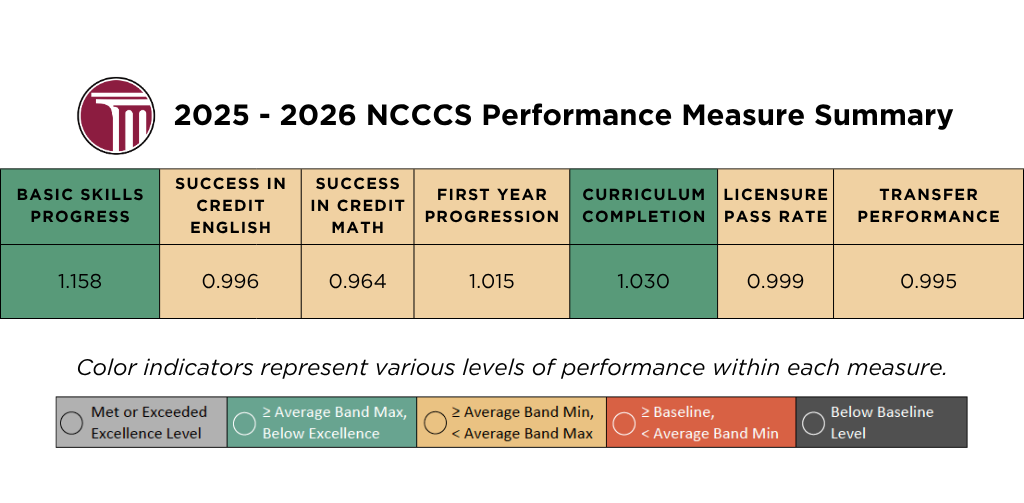
The Performance Measures for Student Success Report is the North Carolina Community College System’s primary accountability document. It provides an annual summary of data to inform both colleges and the public about the performance of North Carolina’s 58 community colleges.

NCCCS Performance Measures - Baseline Levels Information

History and Purpose
Since 1993, the State Board of Community Colleges has monitored specific performance data to maintain public accountability for college programs and services. In 1998, the General Assembly directed the State Board to set standards for the quality of community college offerings. A review process established in 2010 ensures the measures remain relevant, focusing on student success. Every three years, a committee of college leaders, experts, and research professionals evaluates the measures and proposes updates, with the most recent approved in 2021.

Current Performance Measures
The measures currently tracked are:

Basic Skills Student Progress (PM1)Index score based on percentage of Basic Skills periods of participation (POPs) with a measurable gain (MSG).
Student Success Rate in College-Level English Courses (PM2)Index score based on percentage of first-time associate degree-seeking and transfer pathway students passing a credit-bearing English course with a “C” or better within three years of their first fall term of enrollment.
Student Success Rate in College-Level Math Courses (PM3)Index score based on percentage of first-time associate degree-seeking and transfer pathway students passing a credit-bearing Math course with a “C” or better within three years of their first fall term of enrollment.
First Year Progression (PM4)Index score based on percentage of first-time fall credential-seeking students who graduate prior to or enroll in postsecondary education during the subsequent fall term.
Curriculum Student Completion (PM5)Index score based on percentage of first-time fall credential-seeking students who have graduated, transferred, or are still enrolled during the fourth academic year with 42 successfully completed non-developmental hours.
Licensure and Certification Passing Rate (PM6)Index score of first-time test-taker results on licensure and certification exams. Exams included in this measure are state-mandated exams which candidates must pass before becoming active practitioners. 
College Transfer Performance (PM7)Among community college Associate Degree completers and those who have completed 30 or more articulated transfer credits who subsequently transfer to a four-year university or college during the fall semester, index score based on the percentage who graduate prior or remain enrolled at any four-year college or university the subsequent fall semester.

Baseline and Excellence Levels
Since 2013, an outcomes funding model has defined baseline and excellence levels for each measure, promoting consistency, transparency, and simplicity. Baseline levels are two standard deviations below the system’s average index score, while excellence levels are one standard deviation above. Scores within 0.5 standard deviations of the average are considered within the average band.

Each college’s performance is summarized with color-coded indicators. Color indicators represent various levels of performance within each measure: 

Color Gradients

To help colleges identify potential areas of strengths and weaknesses, some color gradients are included in this report. Colors are based on differences between colleges within categories for each measure. For the color gradients, green represents higher outcomes while red represents lower outcomes. The color scale is below.

 

Data Sources: 

  • CCSR: Comprehensive Curriculum Student Report (formerly known as CRPFA)
  • Diploma Sender: NC’s high school equivalency database for GED, HiSET, TASC, and Multiple Pathways (MPHSE) testing and credentials
  • Graduation Extract
  • Laces: Literacy, Adult, and Community Education System monthly data
  • LEIS: Literacy Education Information System monthly data
  • Licensing Agencies
  • National Student Clearinghouse
2024-2025 Mitchell Community College Performance Summary


2024-2025 NCCCS Performance Measure Report
2023 -2024 Mitchell Community College Performance Summary

2023 -2024 NCCCS Performance Measure Report
2022 -2023 Mitchell Community College Performance Summary

2022 -2023 NCCCS Performance Measure Report

Richmond Federal Reserve Bank Data

The Survey of Community College Outcomes is a tool the Richmond Federal Reserve has developed to better measure the way community colleges are serving their students and communities. Learn more about the survey and learn more about Richmond Federal Reserve’s research.

2024 Survey of Community College Outcomes (PDF)

Survey of Entering Student Engagement (SENSE)

The Survey of Entering Student Engagement (SENSE) helps community colleges discover why some entering students persist and succeed and others do not. SENSE is only administered to curriculum students.

Administered during the fourth and fifth weeks of the fall academic term to students in courses randomly selected from those most likely to enroll entering students. Students respond to the survey in class, and member colleges receive survey reports including data and analysis they can use to improve their programs and services for entering students. Specifically, SENSE data should be useful in improving course completion rates and the rate at which students persist beyond the first term of enrollment. 

SENSE Standard Reports
SENSE Benchmark Reports

SENSE benchmarks are groups of conceptually related survey items that focus on institutional practices and behaviors that promote engagement among entering students. Benchmarks are used to compare each institution’s performance to that of similar institutions and with the SENSE Cohort. The six SENSE benchmarks are: early connections, high expectations and aspirations, clear academic plan and pathway, effective track to college readiness, engages learning, and academic and social support network.

2024 MCC SENSE Benchmark Report (PDF) – All Entering Students

2024 MCC SENSE Benchmark Report (PDF) – Part-Time & Full-Time (Enrollment Status) Entering Students

SENSE Mean Reports

Means reports present an average of each survey item that has scaled responses (e.g., strongly agree to strongly disagrees) and compare average items responses between member colleges and various groups, or between student subgroups with a college. Means are not run-on dichotomous items (those with only two response options). These items are summarized in frequency reports.

2024 MCC SENSE Mean Report (PDF) – All Entering Students

2024 MCC SENSE Mean Report (PDF) – Part-Time & Full-Time (Enrollment Status) Entering Students

SENSE Frequencies Reports

Frequency reports present the observed frequencies of occurrence (counts and percentages) of the values for each survey item (excluding demographic survey items). These reports are useful for understanding how data are distributed across response categories. Counts and percentages on frequency reports are subjects to rounding.

2024 MCC SENSE Frequencies Distribution Report (PDF) – All Entering Students

2024 MCC SENSE Frequencies Distribution Report (PDF) – Part-Time


SENSE Special Focus Module Report – Culture of Caring

2024 MCC SENSE Frequencies Distribution Report Culture of Caring (PDF) – All Entering Students

2024 MCC SENSE Frequencies Distribution Report Culture of Caring (PDF) – Part-Time

Voluntary Framework of Accountability (VFA)

The Voluntary Framework of Accountability (VFA) is the first comprehensive national accountability system created by community college, for community colleges. Community college leaders – facilitated by the American Association of Community Colleges (AACC) – conceived, developed, and pilot-tested the VFA metrics.

Key Performance Indicators (KPIs): New Metrics for the Voluntary Framework of Accountability (PDF)

Comparison of Mitchell Community College’s IPEDS (federal) graduation rate to the college’s VFA Six-Year Outcome (PDF)

More Information

Existing accountability measures in higher education do not adequately measure the unique mission of community colleges. For example, existing measures may exclude part-time students or non-credit career and technical students who are a key part of community college’s mission. In light of the inadequacy of existing measures, the VFA stands to provide community colleges with a significantly improved ability to assess their performance, identify areas for improvement, and demonstrate their commitment to their mission.

The VFA has three parts: measures of student progress and outcomes; measures of workforce, economic, and community development; and an approach for assessing student learning outcomes.


Outcomes Internal Reports include the data that colleges are required to report (Student Progress and Outcomes (SPO) Measures) and the data that are optional (Career and Technical Education (CTE) Measure and Adult Basic Education (ABE) Measures) to report.

Student Progress and Outcomes (SPO) Measures is the umbrella term for multiple measures. These measures capture incoming student populations and document progress by the end of their first year, process and attainment outcomes by the end of their first two years, and outcomes by the end of six years.

Career and Technical Education (CTE) Measures are designed to assess the value of education and training in job-specific programs to the students who have completed a program or have had significant exposure to training in these areas.

Adult Basic Education Measures provide a metric for education and preparation for passing a GED or other high school equivalency are important missions for many community colleges. The metrics in this area look at enrollments and transitions from ABE course work or programs into further education or the workforce.

Contact

Randy Ledford, Vice President for Learning | SACSCOC Liaison
rledford@mitchellcc.edu
(704) 878-3264

Cassie Forbes, Director of Data Analysis and Research
cforbes2@mitchellcc.edu
(704) 579-6806

Lisa Miller, Director of Strategic Planning and Assessment
lmiller@mitchellcc.edu
(704) 978-5498